Glockenspiel vs Xylophone – What Are The Differences?
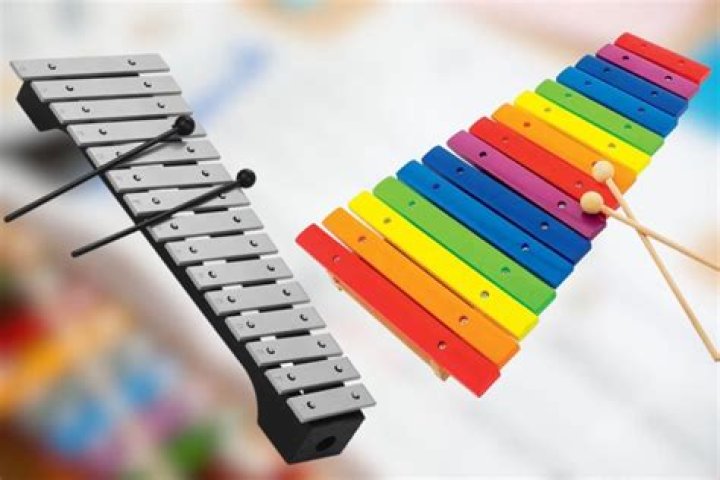
Given a quick look, these are two instruments that look more or less the same. They both come from the percussion family of instruments, so you may wonder if there is a difference between them. And if so, what is it? So, I decided to take an in-depth look and compare the Glockenspiel vs Xylophone.
Table of Contents
The Glockenspiel and the Xylophone
It is fair to say that there are some similarities between the xylophone and glockenspiel. For example:
- They look alike.
- Both are percussion instruments.
- You strike them with a hammer or mallet to make the sound.
But that is where the similarities end. From here on, they are very different instruments, as we are going to find out. I will look at the similarities and differences again at the end in more detail. But let’s first look at a little of the history behind both instruments.
The Glockenspiel
Not too difficult to establish the roots of this instrument. “Glocken” is the German word for bells. “Spiel” in German means either a game or to play.
The Glockenspiel was first created in Germany in the 17th Century. However, it can be recognized by different names depending on where you are in Europe. In France, it is known as a “Carillon.” In Italy, it is sometimes referred to as a “Campanelli.”
The Xylophone
There are some disagreements about where the instrument originated from. The word “Xylo” is a Greek word meaning wood. So, that gives us a bit of an indication. But then it also has links to both Africa and Asia.
A couple of years ago, I went on a river cruise up the Chao Phraya river in Bangkok. During the evening, a man got out this strange instrument. It looked like a xylophone but was suspended by string at each end of a frame. It resembled a “hanging” xylophone.
A Traditional Instrument From Asia?
It had wooden keys that he struck with small hammers. I asked what it was. They told me the name and said it was a traditional instrument from Isaan, the country farming area in northeastern Thailand. They had used the instrument for thousands of years, I was told.
So Greece, Africa, or Asia, take your pick. The fact that this instrument had wooden keys, though, was interesting. Just a little about the origins of both. Let’s take a closer look at each instrument.
The Glockenspiel
This instrument is built with a series of steel bars that act as keys providing notes. The original glockenspiel was built with bells rather than bars. But it became apparent that the bars would be easier to play and move around.
The steel bars are arranged, rising through their tones. Much the same way as the keys on a piano. Additionally, they are arranged according to the tone they produce.
They sit horizontally on their frame, and the keys are arranged similarly to the keyboard on a piano. As with the piano, the black keys are above the white keys. They are not colored black and white. They are placed in the positions the black keys would be in on a keyboard.
A percussion piano?
It needs no amplification because the bars are made of metal. That means they act with the outer case of the glockenspiel as a resonator when struck with a hammer or small mallet.
You will find most glockenspiels to have a tonal range between two and a half and three octaves. Approximately G5 to C8. In some instruments, the steel bars have been replaced with steel tubes.
How Is It Played?
There are two ways to play the glockenspiel, which is one of the reasons it is a popular instrument. If you want a loud, bright tone, then you can strike the bars or tubes with a hard mallet. To achieve a softer, more subtle sound then, you would use a soft rubber mallet.
You can also play the glockenspiel vertically using a scaled-down version with the correct fittings. You will sometimes see this version in marching bands.
The Xylophone
A similar setup in terms of how it looks except that the xylophone, as we have already seen, has wooden bars instead of metal. The bars are graduated to produce certain notes. Usually, it will cover a range of about three to four octaves. Each of the bars is tuned to a particular note in the musical scale.
The wooden bars are struck with wooden mallets to create the sound. They are made from Rosewood. Unlike the glockenspiel that resonates by itself through its steel bars, the xylophone cannot do that.
Underneath the wooden bars are placed metal resonators. These amplify the sound whilst also giving the instrument plenty of sustain.
The Marimba
This is another instrument very similar to the xylophone but should not be confused with it. The xylophone sound is much brighter and higher in the tonal register. And the marimba is generally a larger instrument.
The Xylophone Sound
It is easy to pick out the unique sound of a xylophone, even amongst an orchestra. The timbre is quite hard and, if you like, wood-sounding. However, the sound has changed somewhat over the years as the bars become made of alternatives to wood.
Today you will also find bars made from fiberglass or specially reinforced plastic. As a result, both options produce a louder but slightly different sound.
A Variety of Sizes
You will find different sizes of xylophones, with some even made for juniors just learning. I have enclosed an example at the end of this article. Furthermore, sizes range from two and a half octaves up to the standard size of 3.5 to 4 octaves.
Glockenspiel vs Xylophone – Main Differences
Let’s just remind ourselves of the differences between a glockenspiel and a xylophone.
Differences
- Glockenspiel bars are made of steel; the xylophone bars are primarily wooden.
- The glockenspiel has a smaller range than the xylophone.
- A typical glockenspiel has a range of about two and a half octaves; the xylophone has a range of three and a half to four octaves.
- Typically the glockenspiel has a higher pitch than the xylophone.
- Because there are fewer soundbars in the glockenspiel, it tends to have a smaller build.
- There is a difference in sound; the glockenspiel sound is bell-like, the xylophone has short sharp tones.
- Mallets for the glockenspiel are hard, made of metals or hard plastics.
- Mallets for the xylophone are soft and made of rubber or softer plastic.
- The glockenspiel doesn’t need an extra resonator.
- The xylophone has a metal resonator built-in under the wooden bars.
Similarities
There is quite a list of differences and far fewer similarities between them.
- They are both recognized as percussion instruments.
- Both instruments are played by striking the bars with mallets.
- They both have designs like a piano keyboard.
- Both instruments offer the feature of being able to ‘double-up’ their sound.
Although, it’s quite clear that while they have certain similarities, they are both their own instrument. Here are some examples of both currently available.
- Eastar Advanced 32 Note Glockenspiel
- CeleMoon 15 Tone Glockenspiel for Kids
- Lfhelper Portable Professional 25 Key Xylophone
- MUSICUBE Xylophone for Kids Wooden Xylophone with Mallets
Interested in Percussion Instruments?
And if you need some quality percussion sounds for your next DAW project, then take a look at our detailed reviews of the Best Xylophone VST, the Best Marimba VSTs, the Best Timpani VST, the Best Keyboard Synthesizer, and the Best Drum Machines currently on the market.
Glockenspiel vs Xylophone – Final Thoughts
Despite the differences, you will usually find both instruments in symphony orchestras. And they certainly offer an alternative sound in that environment.
If you can play piano at any level, then you should be able to learn either instrument relatively easily. It might be worth adding another string to your musical bow to do that.
Until next time, let your music play.